

Sequencing State Policy and Telecom Licensing in a Layered Regulatory Framework Foreign satellite operators evaluating Thailand are not facing two separate regulatory regimes. They are navigating a layered framework in which telecommunications licensing and state-level policy considerations operate within the … Read More
telecom
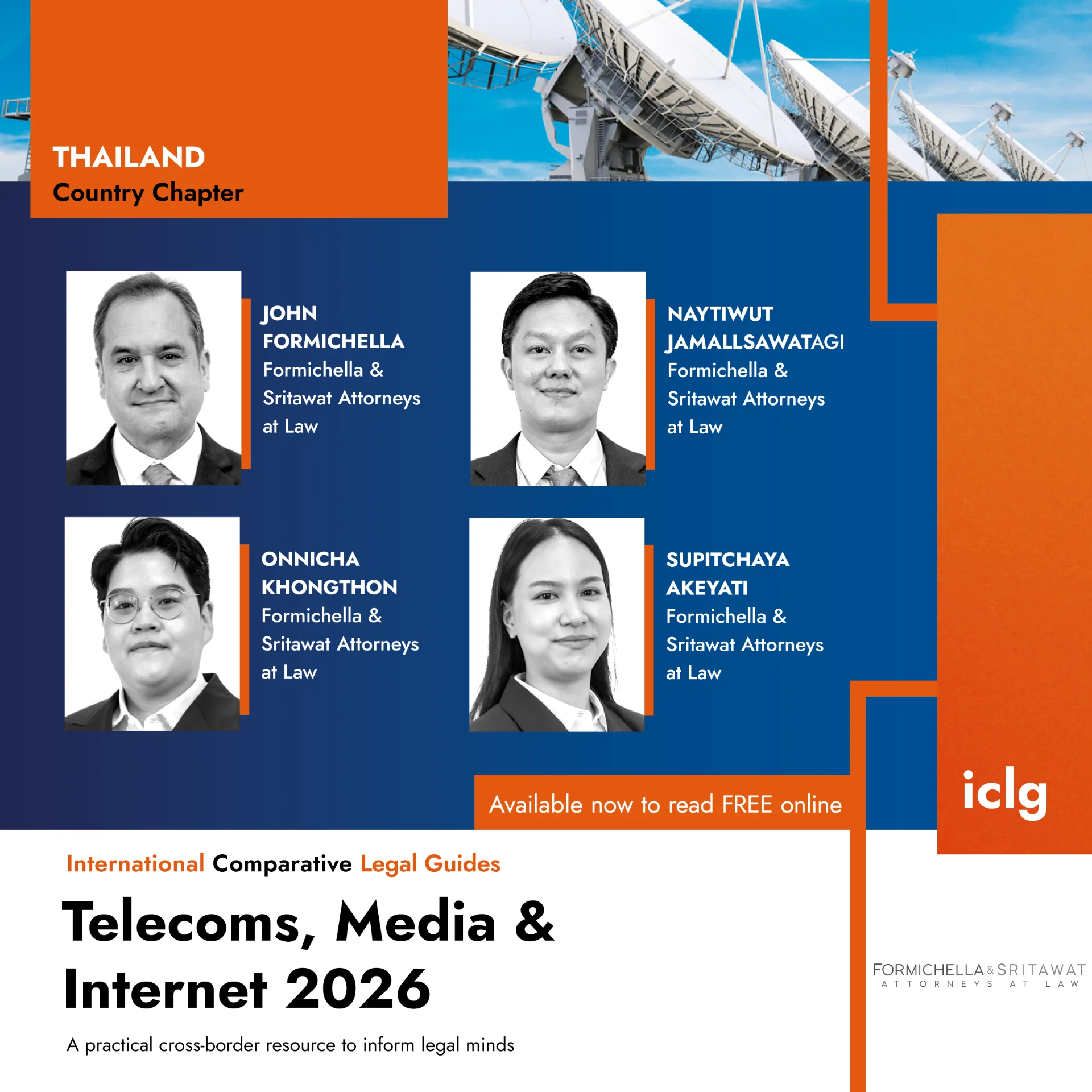
Formichella & Sritawat contribute Thailand Chapter of ICLG Telecoms, Media & Internet Laws and Regulations 2026
We are pleased to announce that the Thailand chapter of the International Comparative Legal Guide (ICLG): Telecoms, Media & Internet Laws and Regulations 2026 has now been published by Global Legal Group . The chapter provides an up-to-date overview of … Read More

Thailand Digital Platform Regulation 2025: Draft PEA, CCA, Lèse-Majesté and Compliance Obligations
I. Introduction: Thailand’s Regulatory Crossroads Thailand’s digital regulatory model is undergoing a structural realignment. For most of the past two decades, online enforcement rested primarily on the Computer Crime Act (CCA), criminal defamation, and traditional Criminal Code provisions. These regimes … Read More

Understanding Regulatory Reasoning in Thailand’s Digital Communications Framework (2025 Update)
November 2025 A clear and strong regulatory framework oversees Thailand’s telecommunications and media industries (see https://fosrlaw.com/2024/telecommunication-licensing-in-thailand/). The Ministry of Digital Economy and Society (MDES) creates national strategies for connectivity, data management, and digital transformation. Meanwhile, the National Broadcasting and Telecommunications … Read More
OTT and the Definition of Television Broadcasting in Thailand
Over-the-top (OTT) services like streaming platforms are now a vital part of Thailand’s digital landscape. They play a huge role in how people enjoy media, and they’re becoming a focal point for policymakers, courts, and regulators when it comes to … Read More

Foreign Satellite Operators in Thailand: NBTC Approval and Equipment Licensing Requirements
Foreign Satellite Operators in Thailand – Service and Equipment Approvals Required
The National Broadcasting and Telecommunications Commission (NBTC) has addressed the activity by a foreign satellite operator offering direct-to-device connectivity. The NBTC reiterated that providing satellite internet services in Thailand without a license is unlawful. This clear position underscores the regulator’s heightened scrutiny of foreign market entry in the satellite sector.
Key Requirements
Type III License Required
Foreign satellite operators cannot lawfully provide services in Thailand without a Type III telecommunications business license issued by the NBTC.
Local Partner Structure
A Thai-licensed Type III operator must serve as the official licensee and compliance anchor, ensuring adherence to national security, interception, and consumer protection obligations.
Equipment Licensing
Satellite user terminals, ground stations, and direct-to-device equipment cannot be imported, sold, or used in Thailand without prior approval from the NBTC.
NBTC Enforcement
The regulator has shown that promotional activity alone may trigger regulatory action—equipment imported without authorization risks seizure at the border.
Conclusion
Thailand welcomes innovation in satellite communications; however, market entry requires full compliance with the NBTC’s regulations. The regulator’s recent action highlights the risks of unauthorized activity. Foreign operators should obtain both service and equipment approvals before entering the Thai market.
Formichella & Sritawat advises global technology and satellite companies on NBTC licensing, equipment approvals, and regulatory strategies for lawful entry into Thailand.

Partner-Market Partnerships: Foreign Telcos and Type I Licensing in Thailand
Thailand’s Type 1 license regime presents two contrasting stories: on one hand, the fall of many domestic retail MVNOs (see https://fosrlaw.com/2025/thailand-mvno-type-1-license-challenges/); on the other, the steady, behind-the-scenes activity of foreign operators working through partner-market agreements. Our accompanying articles help explain these different paths, showing why local MVNOs faced challenges while foreign carriers continue to use Type 1 licensing to support enterprises. … Read More

Why so few MVNOs? It’s the economics. An in-depth look at MVNOs in Thailand Under the NBTC Type 1 License?
Thailand’s telecom regulator, the National Broadcasting and Telecommunications Commission (NBTC), has introduced the Type 1 telecommunications license to encourage more competition among service providers, including Mobile Virtual Network Operators (MVNOs). These operators, by design, don’t own their own telecommunications infrastructure … Read More

Why The NBTC Might Say No: Unraveling Thailand’s Type III License Rejections
NBTC’s Discretionary Rejections of Type III License Applications Thailand’s telecom regulator, the National Broadcasting and Telecommunications Commission (NBTC), has shown that meeting formal criteria on paper does not guarantee license approval. The NBTC actively exercises discretion to deny Type III … Read More

Thailand’s Media Revolution: Navigating Broadcasting, OTT, and Film Laws in 2025
Thailand’s media landscape is undergoing a seismic shift in 2025! From stringent NBTC broadcasting rules to emerging OTT regulations and film censorship reforms, the Kingdom is balancing innovation with tradition. Discover lucrative incentives for foreign productions—up to 30% cash rebates—and navigate compliance challenges with expert insights from Formichella & Sritawat. Dive into the future of Thailand’s media revolution today! … Read More